The chest freezer that has been humming in your garage since 2004 is not, legally speaking, an ordinary piece of junk. It is a controlled item, and the rules governing what happens to it are federal, enforced, and the direct reason appliance disposal costs what it does.
This is not a case of regulation for its own sake. The gases inside a refrigeration circuit are among the most potent greenhouse agents in commercial use, and the older ones destroy stratospheric ozone. Here is what the law actually requires, what a certified technician does, and what any of it means for a homeowner with an appliance to get rid of.
What the law requires
Section 608 of the Clean Air Act makes it illegal to knowingly vent refrigerant to the atmosphere during the maintenance, service, repair or disposal of appliances containing it. The requirement has been in force since 1995 for ozone-depleting refrigerants, and was extended to cover substitute refrigerants — the HFCs that replaced them — from 2016.
In plain terms: before a refrigerator, freezer, air conditioner or dehumidifier can be scrapped, crushed or shredded, the refrigerant must be recovered by a technician holding EPA Section 608 certification, using recovery equipment certified for the purpose. That obligation travels with the appliance. It applies to the manufacturer, to the retailer, to the hauler, and to the scrap yard.
Penalties are civil and can be substantial per violation per day. More practically, no legitimate scrap processor will accept a sealed refrigeration unit without documentation that recovery has been carried out, which means the requirement is enforced commercially long before it is ever enforced by a regulator.
Which appliances are covered
Refrigerators, freezers, chest freezers, wine coolers, window and portable air conditioners, dehumidifiers, heat pumps, water coolers with a chilled tap, and commercial refrigeration of every kind. Washers, driers, dishwashers, ovens and ranges contain no refrigerant and are not covered — though they carry their own considerations, covered below.
Why the gases matter this much
The refrigerants used in domestic appliances fall into three generations, and which one your appliance contains depends almost entirely on its age.
| Generation | Typical era | Example | Environmental profile |
|---|---|---|---|
| CFC | Pre-1995 | R-12 | Strongly ozone-depleting; global warming potential in the thousands |
| HCFC | 1990s – 2000s | R-22 | Ozone-depleting; high global warming potential |
| HFC | Mid-1990s onward | R-134a | Not ozone-depleting; global warming potential still roughly 1,400× CO₂ |
The figure worth holding onto is that last one. Releasing the refrigerant charge from a single old domestic refrigerator can be climate-equivalent to driving several thousand miles. It is a small quantity of gas doing a very large amount of work, which is why the recovery requirement exists at the level of the individual appliance rather than the fleet.
There is a second, less discussed component in pre-2005 units: the insulating foam in the walls was frequently blown with the same class of gases, and it holds a charge comparable to the circuit itself. Recovering that requires shredding the cabinet in a sealed chamber, which happens at specialist facilities in some jurisdictions and not at all in others. Where it is not available, the foam charge is lost — a genuine gap that the industry does not advertise.
What actually happens to your fridge
The route from your garage to a scrap bale runs through more steps than most people imagine.
Refrigerant recovery
A certified technician attaches a recovery machine to the circuit, evacuates the refrigerant into a certified cylinder, and records the quantity. The recovered gas is either reclaimed to purity specification and resold, or destroyed. Both routes are documented, and that documentation is what the scrap processor asks for.
Hazardous component removal
Older appliances contain a small collection of components that must come out before the shell can go anywhere:
- Mercury switches in units built before roughly 2000, typically in the door light circuit or a chest freezer lid.
- PCB-containing capacitors in units built before the late 1970s — rare now, but not extinct in a Northland garage.
- Compressor oil, which is contaminated by residual refrigerant and drained and handled separately.
- Used oil filters and driers from the refrigeration circuit.
Materials recovery
What remains is genuinely valuable. The compressor is a dense block of steel and copper. The cabinet is steel. The condenser coils are copper or aluminium. The shelving is glass and steel. A stripped refrigerator is a good piece of scrap — which is exactly why the fee you pay covers labour and compliance rather than the metal itself.
What it costs, and why
Our flat rate for a large appliance is $200, including collection from anywhere in the property, loading, transport, compliant disposal and sales tax. There is a published $50 surcharge where the appliance requires elaborate plumbing disconnection — a hard-plumbed dishwasher or an ice-maker line, rather than a washing machine on isolator valves.
The multi-item discount applies here as everywhere, and it applies to every item rather than to the second one only. Clearing a kitchen of three appliances is $150 each — $450 rather than $600. If you are replacing a set, book them on one visit.
"Free" appliance collection deserves a question
Scrappers who advertise free collection of appliances are, in the legitimate case, funding the service from scrap value and absorbing the recovery cost. In the less legitimate case, the refrigerant is being vented in a yard and the shell sold as clean steel. Ask who performs the recovery and whether they hold Section 608 certification. An honest operator answers immediately; the question itself is diagnostic.
Appliances without refrigerant
Washers, driers, dishwashers, ranges and water heaters are simpler but not entirely free of considerations.
Gas appliances must be disconnected by somebody competent to do it. We will not disconnect a gas line, and neither should you. Arrange it in advance with a qualified trade — a crew arriving to find a live gas connection has to reschedule.
Water heaters need to be drained before removal. A 50-gallon tank holds around 400 pounds of water, which is both a carrying hazard and, if it goes over on a staircase, a flooring problem.
Washing machines hold residual water in the drum and pump. Run a spin cycle and drain the filter the day before, or expect a trail across the floor.
Microwaves contain a capacitor that holds a dangerous charge long after unplugging. Do not open one. As junk they are unremarkable; as a DIY project they are genuinely hazardous.
What to ask any hauler
Four questions separate a compliant operator from one you should not use, and all four have quick answers if the answer is good.
- Who performs the refrigerant recovery, and are they Section 608 certified? The answer should be immediate and specific.
- Where does the appliance go afterwards? A named facility, not "a recycler".
- Is the disposal fee included in the quoted price? With us it is; with some operators it appears later.
- Do you handle mercury switches separately? A yes indicates somebody who knows the actual requirements rather than the headline one.
Before we arrive
Five minutes of preparation, none of it involving lifting:
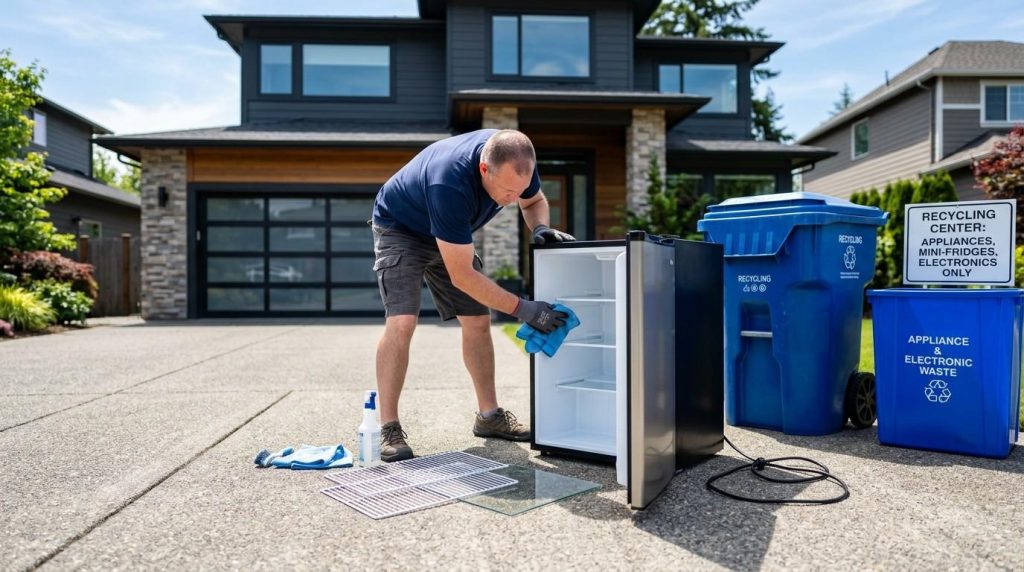
- Defrost the freezer at least 24 hours ahead. The most important item on this list, and the one most often skipped.
- Empty it completely, including door shelves, cutlery baskets and filters.
- Unplug it and coil the cord so it cannot catch on a stair edge.
- Turn off the water at the isolator valve for anything plumbed in.
- Tape the door shut — this is a genuine child-safety measure, not a convenience, for any unit sitting outside before collection.
- Clear and light the route from the appliance to the door.
The short version
Refrigerant recovery is federal law, not an optional environmental gesture. It requires a certified technician and certified equipment, and it is the reason a fridge costs more to dispose of than its scrap value implies. Any operator offering to take it for nothing should be asked how the recovery is being paid for — and the quality of the answer tells you most of what you need to know.
Need this handled rather than explained?
Call (218) 461-1436 or send us the details. Flat rates, sales tax included, and a firm quote on the first call for anything on the published list.