"Where does it actually go?" is the second question we get asked, right after price. It deserves a real answer, because the honest one is more interesting than either of the two stories the industry usually tells — that everything is recycled, or that everything is buried.
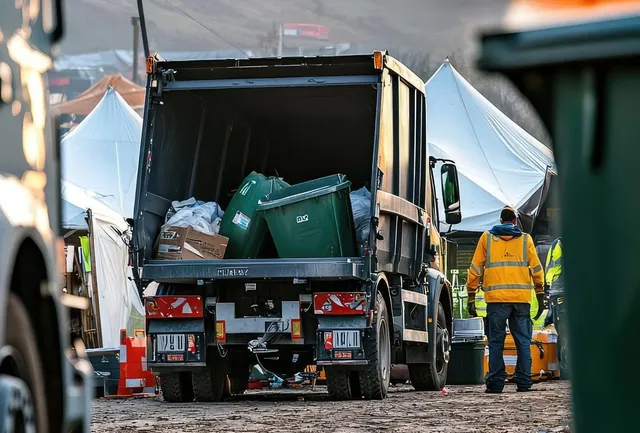
Neither is true. What actually happens is that a full trailer gets taken apart into five or six streams, each with its own destination, its own economics and its own set of rules. Here is that journey, from a Duluth driveway to the final scale house, with the money shown at each stop.
Stop one: the driveway
Sorting begins before the trailer moves, and it begins for a commercial reason rather than an environmental one. Material that can be routed to a recycler is material we do not pay landfill tipping fees on — and on you-pack jobs, where you reimburse disposal at cost plus ten percent, that saving lands directly on your invoice rather than ours.
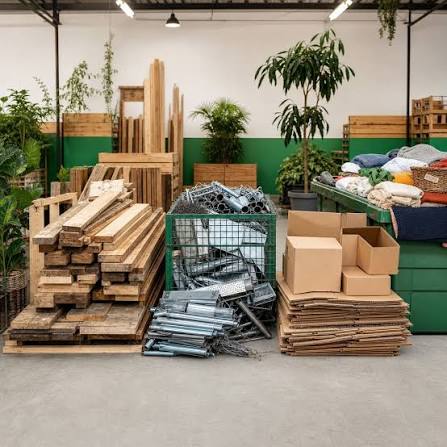
A crew loading a mixed household job is making continuous decisions: clean metal to one corner, electronics kept upright and unbroken, mattresses kept dry, timber kept free of contamination, and general waste filling the gaps. It looks like packing. It is actually pre-sorting, and it is the highest-leverage ten minutes in the whole chain, because separating material at the source costs nothing while separating it later costs labour.
Why we ask you to keep metal in its own pile
Clean scrap metal frequently has positive value — the yard pays us rather than charging us. Mixed into a general load it becomes landfill weight you pay to bury. That is why the request appears on our preparation checklist, and it is worth more than most people assume on an appliance-heavy job.
Stop two: the materials recovery centre
In the Twin Ports the primary destination is the WLSSD Materials Recovery Center. Its published fee schedule is a mix of per-item charges and weight-based rates, and it is worth reading before any large project, because it explains a great deal about the shape of junk removal pricing generally.
One feature of that schedule catches almost everyone out, so it is worth stating plainly. Resident allowances — the "one free per day" provisions, such as one free microwave per household per day — do not apply to a commercial hauler. Yours will not be the only microwave on our trailer that day, so it will not be free. Every per-item allowance in the schedule works the same way.
This is precisely why our trailer service reimburses disposal at cost plus ten percent rather than folding it into a single figure. You can read the schedule, see what the facility charged, and check the arithmetic yourself.
What comes off the trailer, and where it goes
| Stream | Destination | Typical economics |
|---|---|---|
| Clean scrap metal | Regional scrap yard | Positive value — the yard pays |
| Appliances with refrigerant | Certified recovery, then scrap | Per-unit fee; recovery is federally required |
| Electronics and CRTs | Certified e-waste processor | Per-item fee; CRTs are the most expensive category |
| Mattresses | Dismantler where one operates | Per-unit fee, below landfill cost |
| Clean timber | Wood recovery / biomass | Low per-ton rate |
| Cardboard and paper | Recycling stream | Low or nil where clean and dry |
| General residual | Landfill | Highest per-ton rate |
Scrap metal: the stream that pays
Metal is the one category where the economics run the right way. Steel, aluminium, copper and brass all have established markets, and a yard will weigh a load and pay for it rather than charge to take it.
The catch is contamination. "Clean" scrap means metal that is genuinely metal — a steel bed frame, a cast iron radiator, aluminium guttering. A sofa with a steel frame inside upholstered fabric is not clean scrap; separating it costs more labour than the metal is worth, so it goes to general waste. This is why an old bed frame is cheap to dispose of and an old sofa bed with an identical amount of steel in it is not.
Prices move with global commodity markets, which is one reason disposal costs fluctuate year to year in ways that have nothing to do with local policy. A drop in the steel price genuinely does move the economics of a garage clear-out.
Appliances: regulated before they are recycled
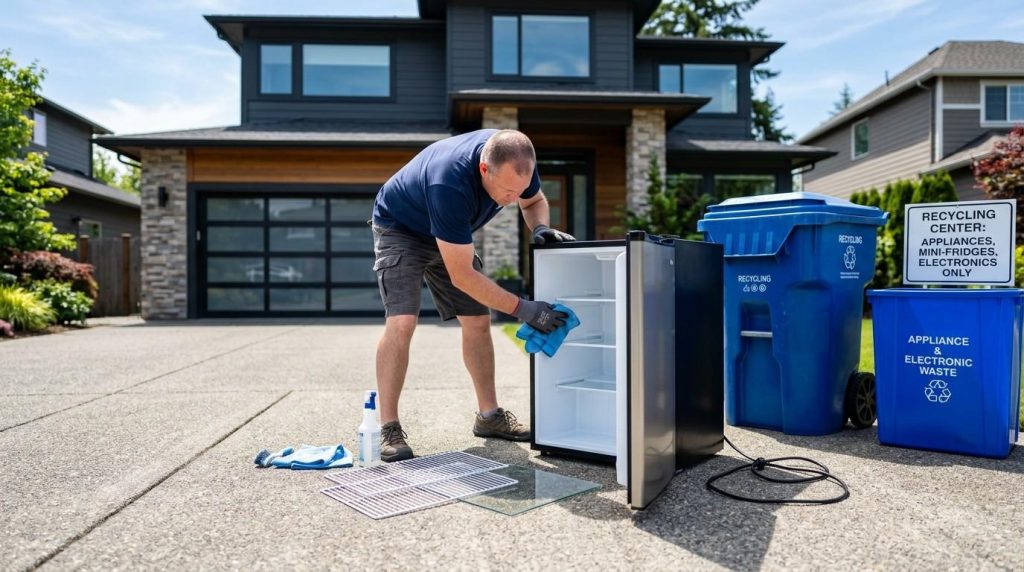
Anything containing refrigerant — refrigerators, freezers, air conditioners, dehumidifiers — cannot simply be crushed. Under federal law the refrigerant has to be recovered by a certified technician before the shell can be scrapped, because both the older CFC and HCFC gases and the newer HFCs are potent greenhouse gases and, in the older cases, ozone-depleting.
So an old chest freezer takes a longer route than its scrap value suggests: refrigerant recovery, then removal of any mercury-containing switches or capacitors, then oil draining, and only then the shell enters the metal stream. Each of those steps is labour, which is why appliance disposal carries a per-unit fee that a bare steel frame of the same weight does not.
We cover this in detail in our guide to appliance recycling and refrigerant law, including what to ask any hauler before you hand over a fridge.
Electronics: the expensive end
Electronics go to certified processors rather than general recycling, because they combine genuinely valuable material — gold, copper, palladium — with genuinely hazardous material: lead, cadmium, mercury and brominated flame retardants.
Cathode ray tube televisions and monitors are the hardest case in the entire waste stream. A large CRT contains several pounds of lead bonded into leaded glass, and the market that once absorbed that glass for new tube manufacture no longer exists, because nobody makes tubes. The result is a material with real disposal cost and essentially no downstream value.
That is the whole explanation for a pricing structure people frequently query: a tube television over 32 inches is $250 to remove while a flat screen over 40 inches is $150. It is not about size or weight. It is about what the receiving facility charges us for leaded glass versus a flat panel.
Be sceptical of free electronics collection
Legitimate e-waste processing costs money. Where an operator offers to take televisions and monitors free of charge, ask where the material goes and whether they hold R2 or e-Stewards certification. Historically, a meaningful share of "free" collection ended up exported to jurisdictions with weak enforcement and dismantled by hand without protection.
Mattresses: bulky, banned, and increasingly recycled
A mattress is close to the worst possible landfill item. It is mostly air, so it consumes disposal volume out of all proportion to its weight; it compresses poorly; and it can trap gas pockets in a compacted cell. Many facilities either surcharge them heavily or refuse them outright, which is why they are excluded from most curbside collection.
Where a dismantler operates within economic reach, a mattress can be taken apart into genuinely useful streams: steel springs to scrap, foam to carpet underlay, fibre to industrial felt, and timber from the frame to biomass. Somewhere between 75 and 90 percent of a conventional innerspring mattress is recoverable this way.
The constraint is geography. Dismantling is labour-intensive and only viable where volume justifies a facility, which in practice means metropolitan areas. Our guide to mattress disposal in Minnesota covers what is realistic in this region specifically.
The last stop: what genuinely has to be buried
After every viable stream has been pulled out, a residual remains, and honesty requires saying so. It is upholstered furniture, mixed-material items that cannot economically be separated, contaminated or wet material, treated timber, and a long tail of composite objects that no single recycler wants.
That material goes to a lined, engineered landfill, weighed in at the scale house and charged by the ton. Modern landfill is not a hole in the ground: it is a lined cell with leachate collection and, increasingly, gas capture that runs a generator. It is the right destination for material with no better one, and it is a genuinely bad destination for material that had one.
Across our own jobs, roughly 94 percent of incoming material by weight is diverted from landfill — a figure driven overwhelmingly by metal and appliances, which are heavy, and dragged down by upholstered furniture, which is bulky but light.
Why we show you the numbers
Most haulers quote a single figure with disposal buried inside it. That is simpler, and it also makes it impossible to tell whether you are paying for a tipping fee or a margin.
We publish flat rates for standard residential items because those jobs are standardised enough to price honestly in advance. For trailer work — where the load is genuinely unpredictable — we charge the facility's published fee plus a transparent ten percent, and hand you the facility's figures with the invoice.
It occasionally means a customer works out that a particular item is not worth taking, and tells us to leave it. We would rather that than a quote nobody can interrogate.
Three things that improve the outcome
Keep it dry. Wet cardboard, wet timber and wet mattresses drop out of their recycling streams and into general waste. A tarpaulin over an open trailer overnight materially changes where the load ends up.
Do not bag mixed material. A sealed bag of unknown contents cannot be sorted at the trailer and defaults to general waste. Loose is better than bagged for anything that is not genuinely rubbish.
Separate the metal. It is the one thing you can do that reliably reduces both the environmental footprint and the bill.
Need this handled rather than explained?
Call (218) 461-1436 or send us the details. Flat rates, sales tax included, and a firm quote on the first call for anything on the published list.